
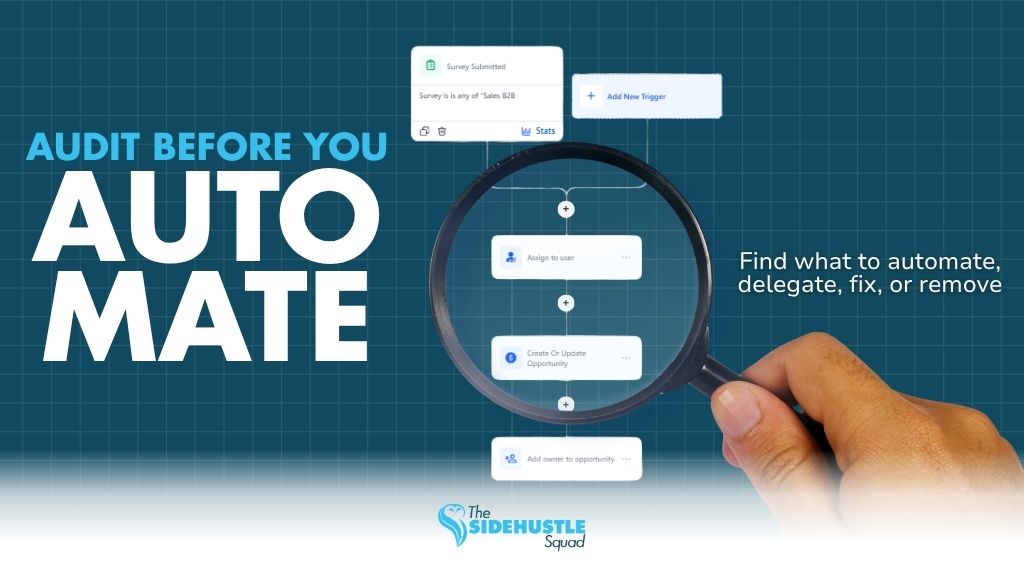
Many business owners assume the solution to feeling overwhelmed is simple:
“Maybe we just need more automation.”
But adding more tools rarely solves operational problems if the underlying workflow is already messy.
In fact, automating unclear processes usually creates faster chaos.
Before investing in more systems, businesses need something more important:
Visibility. This is where a virtual assistant automation audit becomes valuable.
Instead of asking what should be automated immediately, an audit asks a better question:
What is actually happening inside the business right now?
Because before fixing workflows, you first need to understand them.
Why Businesses Should Audit Before Automating
Automation works best when processes are already clear.
Without understanding how work currently moves, businesses risk automating inefficient habits.
An audit helps businesses:
Avoid Automating Messy Workflows
If a process already feels confusing manually, automating it often makes the problem harder to spot.
Fix the workflow first.
Automate second.
Understand Where Time Is Actually Being Spent
Business owners often underestimate how much time disappears into:
• Repetitive admin
• Manual follow-ups
• Switching between tools
• Searching for information
An audit reveals where time is actually going.
Identify Tasks That Need Human Judgment
Not everything should be automated.
Some tasks require:
• Decision-making
• Communication
• Context
Understanding the difference helps create better systems.
What Is a Virtual Assistant Automation Audit?
A virtual assistant automation audit is a structured review of how work flows through your business.
The goal is to identify:
• What should be automated
• hat should be delegated
• hat should be improved
• What should be removed completely
Think of it as operational mapping.
A virtual assistant becomes valuable during this process because they work directly inside workflows.
They can see:
✅ Where bottlenecks happen
✅ Where repetitive tasks exist
✅ Where information gets lost
✅ Where systems create friction
Instead of guessing what needs fixing, businesses gain clearer operational visibility.
What a VA Reviews During an Automation Audit
A virtual assistant looks at workflows from an operational perspective.
Common areas reviewed include:
Repetitive Manual Tasks
Tasks repeated daily or weekly often create strong automation opportunities.
Examples:
• Data entry
• Status updates
• Recurring emails
• Manual reminders
Client Communication Steps
Communication workflows are reviewed for:
• Delayed replies
• Repeated follow-ups
• Inconsistent handoffs
• Unclear ownership
CRM and Pipeline Movement
Many businesses discover pipeline problems during audits.
Questions include:
✅ Are leads moving properly?
✅ Are stages accurate?
✅ Are follow-ups happening consistently?
Document and File Workflows
Poor document management creates friction.
A VA reviews:
• File organization
• Approval processes
• Naming conventions
• Retrieval speed
Task Handoffs Between Team Members
Operational delays often happen when ownership is unclear.
A workflow audit identifies:
• Duplicated work
• Stalled tasks
• Unclear responsibilities
The Four-Part Framework: Automate, Delegate, Improve, or Remove
After reviewing workflows, tasks generally fall into four categories.
Automate
Tasks that are repetitive and rule-based.
Examples:
• Reminders
• Confirmations
• Recurring updates
• Pipeline triggers
If it happens the same way repeatedly, automation is usually appropriate.
Delegate
Tasks requiring context or human judgment.
Examples:
• Follow-ups
• Communication
• Coordination
• CRM maintenance
These tasks benefit from human support.
Improve
Some workflows are unclear but still necessary.
These require:
• Better documentation
• Simplified steps
• Clearer ownership
Improvement often happens before automation.
Remove
Some processes simply no longer create value.
Examples:
• Duplicate reporting
• Unnecessary approvals
• Outdated manual steps
Removing unnecessary work creates immediate efficiency.
Signs Your Business Needs a Workflow Audit
Many businesses wait too long before reviewing operations.
Common indicators include:
You Use Too Many Tools
If work requires jumping between multiple systems constantly, there may be workflow problems.
You Repeat the Same Task Daily
Repetitive work often signals automation opportunities.
Leads or Tasks Get Missed
Missed follow-ups usually indicate operational gaps rather than employee problems.
You Cannot Explain Your Process Clearly
If workflows exist only in your head, scalability becomes difficult.
How The Side Hustle Squad Helps Businesses Find Workflow Gaps
At The Side Hustle Squad, we believe operational improvements should be practical.
That means combining:
VA Support
Virtual assistants help review, document, and maintain workflows.
Automation-Assisted Operations
Automation supports repetitive work while humans manage exceptions and oversight.
Scalable Workflow Improvement
Instead of building complicated systems immediately, we focus on creating workflows businesses can realistically maintain.
Because sustainable systems are usually simple systems.
Most businesses do not have an automation problem.
They have a visibility problem.
Before adding new tools, workflows should be reviewed first.
A virtual assistant automation audit helps businesses identify:
✅ What should be automated
✅ What should be delegated
✅ What should be improved
✅ What should disappear entirely
Because the goal isn’t simply to work faster.
It’s to build workflows that actually work.
👉 Want help identifying operational bottlenecks and workflow gaps?