
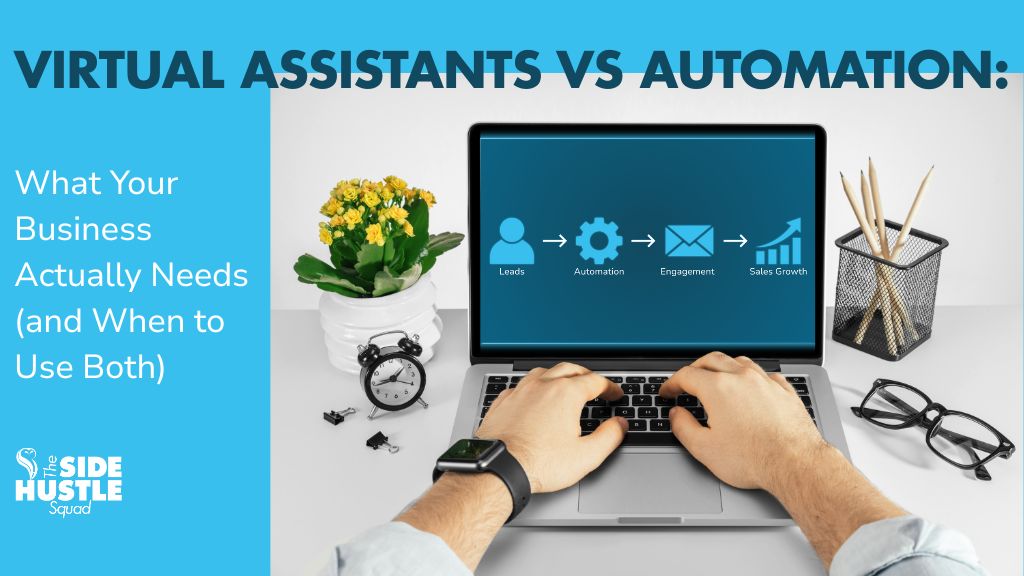
Why This Is the Wrong Question to Ask
When business owners ask whether they need a VA or automation, they’re usually reacting to overwhelm.
Too many tasks.
Too many follow-ups.
Too many systems.
Not enough time.
But the real question isn’t “Which one should I choose?” It’s “What needs to be handled by systems, and what still needs human judgment?”
Automation and virtual assistants solve different problems. Understanding the difference helps you build operations that actually scale without creating new bottlenecks.
What Automation Is Best For
Automation is designed to handle tasks that are repetitive, predictable, and rules-based.
If a task follows the same steps every time and doesn’t require decision-making, automation is often the best solution.
Automation works best for:
• Sending follow-up emails
• Triggering reminders
• Updating statuses in a CRM
• Scheduling appointments
• Moving tasks through workflows
• Generating standard reports
These automated business processes reduce human error, improve consistency, and save hours each week.
Automation shines when speed and consistency matter more than nuance.
What Virtual Assistants Are Best For
Virtual assistants excel where flexibility, judgment, and communication are required.
If a task changes often, involves people, or requires interpretation, a human touch matters.
Virtual assistants are best for:
• Managing inboxes and prioritizing messages
• Handling client communication
• Monitoring workflows and exceptions
• Updating systems that automation can’t interpret
• Coordinating across tools and teams
• Improving processes over time
This is where outsourcing operations support becomes powerful. A VA doesn’t just execute, they adapt.
While automation follows rules, VAs handle real-world complexity.
Where Automation Falls Short Without Human Support
Automation is efficient, but it has limits.
It can’t tell when a client's email needs sensitivity.
Can’t decide which task is more urgent today.
Can’t fix broken workflows on its own.
Can’t adapt when your process changes unexpectedly.
This is where businesses run into trouble, automating too early or too much without oversight.
Without human support, automation becomes fragile. When something breaks, everything stops.
That’s why business automation support works best when paired with someone who understands the system and can step in when needed.
How VA and Automation Work Together
The strongest operational setups don’t choose between humans and systems they combine them intentionally.
A VA + automation workflow looks like this:
Automation handles the repetitive groundwork.
The VA manages, monitors, and improves the system.
Automation does the heavy lifting
• Triggers emails
• Moves data
• Updates records
• Sends notifications
The VA provides intelligence
• Reviews outcomes
• Handles exceptions
• Adjusts workflows
• Improves processes
• Communicates with people
This balance creates reliability and flexibility, the two things growing businesses need most.
Real-World Workflow Examples
Here’s how this looks in practice.
Example 1: Lead Management
Automation captures leads and sends initial follow-ups. A VA reviews responses, updates the CRM, and prioritizes warm leads.
Example 2: Client Onboarding
Automation sends contracts, forms, and welcome emails. A VA checks completion, answers questions, and schedules kickoff calls.
Example 3: Inbox Management
Automation filters and tags emails. A VA reviews priority messages and responds where needed.
Example 4: Reporting
Automation pulls weekly metrics. A VA prepares summaries and flags anomalies.
This is a true VA and automation workflow system working in sync with human oversight.
Choosing the Right Setup for Your Business Stage
The best setup depends on where your business is right now.
Early Stage Businesses
Start with a VA.
You need flexibility, learning, and hands-on support before locking in automation.
Growing Businesses
Introduce automation for repetitive tasks. Keep a VA to manage systems and handle complexity.
Scaling Businesses
Lean into both.
Automation handles volume.
VAs handle oversight, optimization, and coordination.
There’s no one-size-fits-all answer, only what fits your operations today.
Common Mistakes Founders Make
To avoid frustration, watch out for these traps:
• Automating broken processes
• Expecting automation to replace decision-making
• Hiring a VA without systems
• Overloading tools without ownership
• Choosing cost over strategy
The most successful businesses build clarity first, then layer support intentionally.
It’s Not VA vs Automation. It’s Strategy vs Guesswork
The real comparison isn’t virtual assistant vs automation.
It’s intentional operations versus reactive growth.
Automation gives speed and consistency. Virtual assistants bring judgment and adaptability.
When combined thoughtfully, they create operations that are resilient, scalable, and human-centered.
At The Side Hustle Squad, we help businesses design workflows where automation and people work together, not against each other.
Because smart scaling isn’t about choosing tools.
It’s about building systems that actually support how you work.
If you’re unsure what your business needs right now, we're happy to help you map it out.